
NYCHA'S CONCEPTION
WHERE IT ALL BEGAN

NYC.gov/records
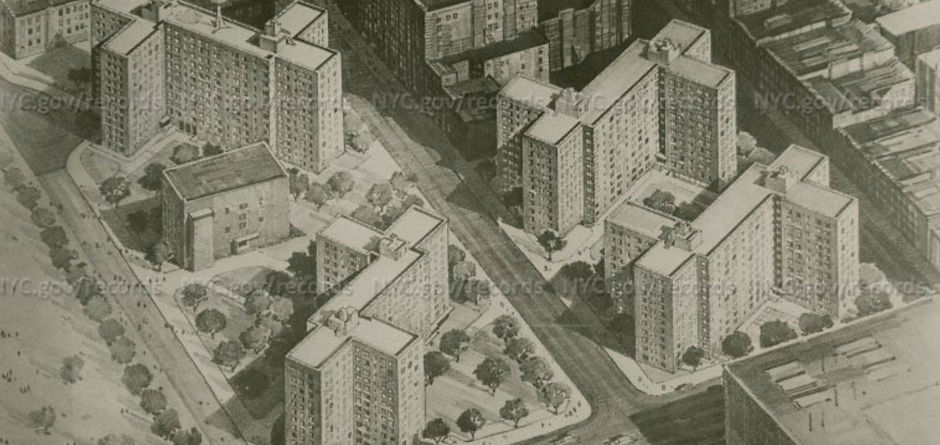
In 1934, during a time when the Great Depression was still lingering, Mayor Fiorello H. La Guardia and his administration cooked up a plan that would sustain the economically challenged in hopes to get them back on their feet. Fiorello came up with an affordable public housing plan, the first agency in the United States to provide publicly funded housing. To all 500,000 residents, this new plan felt like a way out of their disparity. Little did they know, best interests weren’t always kept in mind.
As of 2019, New York City is home to 334 developments holding 178,895 apartments in 2,602 buildings situated on a combined area three times the size of Central Park. According to NYCHA’S 2019 Fact Sheet, NYCHA is “the largest public housing authority in North America.” The population of those that live in NYCHA is around 400,000, but could actually be estimated at 600,000 due to the fact that some residents are living off lease. With NYCHA’s population alone, it could become its own city, similar in size to Washington DC or Boston City.
NYCHA is home to 1 in 15 New Yorkers, many of whom are teachers, police officers, and nurses. Some of New York’s most famous legends include Whoopie Goldberg, Jay-Z, Wesley Snipes, Sonia Sotomayor, and CEO of Starbucks, Howard Schultz, all of whom lived within NYCHA. One would think that with the large community and reputation NYCHA holds, maintenance would be the utmost concern for New York City officials. Unfortunately, starting in the 1980’s, that concern started to hit a heavy decline.
NYC.gov/records
Up until the 1950’s, most of the residents were white and NYCHA maintenance workers were at their prime, tending to properties properly and on time. Fast forward three decades and an influx of black and brown people, NYCHA had taken some hits. The area surrounding NYCHA started to become unsafe and maintenance work was getting put on the back burner.
NYCHA’s conception was not to make poorhouses, but instead houses that could help the poor become working class citizens. With subsidized housing that would reduce the cost of rent, residents did not have to worry so much about making ends meet. According to Luis Ferre Sadurni’s article ‘The Rise and Fall of New York Public Housing’, “From 1953 to 1968, it [NYCHA] excluded most residents on welfare by screening applicants using a list of moral factors, including alcoholism, irregular work history, single motherhood and lack of furniture.” To NYCHA, this ensured that residents who entered the housing complexes could properly maintain their homes as well as respect the community, but to many this seemed like an unjust practice that would later get revoked.
DEFUNDING NYCHA
What Went Wrong?

Shutter Shock
WHO FUNDS NYCHA?
Since 1934, NYCHA depended on federal, state and city governments for aid.
According to a report on the financial budget of NYCHA, “NYCHA generally receives about $2 billion in operating funding annually from the federal government for its public housing and Section 8 programs, and about $300 million annually for its capital program.” With that being said, “NYCHA has been underfunded by a total of nearly $3 billion in federal operating and capital funding since 2001”, stated Executive Vice President for Finance and Chief Financial Officer, Plachikkat V. Anantharam, back in 2019.

'Project Lives' by George Corrano, Chelsea Davis & Jonathan Fisher
CHANGES WERE MADE
Throughout the years, the culture within NYCHA had certainly changed and the buildings reflected that. In 1968, NYCHA abandoned the process of screening those who entered the system and started to allow anyone to live within the buildings. By that time, NYCHA was home to 500,000 New Yorkers, many of whom were minorities.
'Project Lives’, edited by George Carrano, Chelsea Davis and Jonathan Fisher, gives those who live in NYCHA the chance to become photographers, creating their own narrative of what it means to live in public housing. According to ‘Project Lives’, “Federal legislation in the late 60’s capped rent as a percentage of income and rendered American public housing more affordable, yet backfired by undermining building maintenance as housing agency rental income fell off a cliff.” By this time, the amount of white people living within NYCHA began to decline as many moved to the suburbs. Around this time, social issues began to skyrocket; the crack epidemic right around the corner. NYCHA was suddenly caught under fire.
Due to lack of funding over the years, the housing complexes were starting to deteriorate and the neighborhoods were beginning to feel unsafe. Two major factors that contributed to NYCHA’s decline are lack of protection within the community and mismanagement.

'Project Lives' by George Corrano, Chelsea Davis & Jonathan Fisher
LACK OF PROTECTION
The New York City Housing Authority Police Department was created in 1952. The NYCHA PD was a law enforcement agency that was put in place to keep residents who lived in NYCHA safe. The administration realized that these developments, some with populations like small cities, provided some challenges. The initial response was a simple one - the formation of a private security guard corporation with individual guards assigned to specific developments. There were around 2,700 police officers working to keep NYCHA safe. Tenants themselves formed voluntary tenant patrols where residents would sit in lobbies, viewing who would come in and out.
Patrick Conry, Assistant Chief at the New York Police Department and former member of the Housing Authority Police Department describes his first time on patrol at the Farragut Houses. “I got hit with a padlock. It grazed my face. There were some people that did not want us there because we were interfering with their business. I saw objects as big as a living room couch thrown off the roof of a building onto a police car. Those were the bad old days. You don’t hear those stories anymore.”
Come 1995, the NYPD absorbed NYCHA PD and became one. Even though crime was on the rise, “NYCHA could only stand by as some NYPD officers reportedly drew guns unprovoked and others did not dare patrol ill-lit stairwells,” as stated in ‘Project Lives’. Two decades later in 2014, 20% of violent crimes in New York City occured in NYCHA buildings. As drug dealings, muggings and murders became more frequent in the buildings, one of the strategies NYCHA has employed to combat this is the permanent exclusion strategy. This strategy was a way to kick out dangerous individuals who were committing serious and violent crimes, while allowing other members of the household to remain. Unfortunately, sometimes NYCHA kicks out those who fail to pay their rent instead of helping to keep the community safe. According to the Daily News, “Since 2015, DOI (Department Of Investigation) has detailed three times NYCHA's failure to utilize the "permanent exclusion" tool to reduce crime in developments.”
MISMANAGEMENT
While crime rates rose high within the NYCHA buildings, funding cutbacks paved the way for NYCHA’s biggest issue, mismanagement. Leaks, lead poisoning, and lack of heat during the blistering cold months are just some of the issues that NYCHA tenants go through each year.
By the 1980’s, NYCHA had 17,000 employees ready to tend to any issue residents were facing. “In my day, the staff was the best. They had their job, they did their job, and they were qualified for their job. You’d call, and it would be fixed right away”, Elaine Walker, longtime resident of Queensbridge Houses, told the New York Times. Today, if tenants need repairs within their apartments, they should be prepared to put up with their dilemma for months on end. With NYCHA’s backlog consisting of 170,000 open work orders for repairs and counting, it makes it difficult for the administration to keep up. On January 12th, 2020, it was reported that NYCHA residents filed 200,000 complaints for bed bug and roach infestations in 2018 and 2019 and back in Sept. 3, 2019, a report from NY1 revealed that many of the elevators in the authority’s public housing developments were not functioning, preventing residents with disabilities from leaving their homes for days – or, in some cases, for months.
With approximately 13,000 employees to date, serving about 173,946 families and approximately 392,259 authorized residents throughout the city, it’s very easy for repairs to be pushed back. In an article from the New York Times detailing the daily life of a NYCHA superintendent, we learn that trade workers such as carpenters, painters, plumbers and electricians are required to help fix many of the issues within these buildings. The administration on the other hand “has struggled to hire enough of these workers, leading to interminable wait times for basic repairs. A resident with a damaged wall, for example, will wait an average of about 100 days for a plasterer and three months more for a painter to finish the job.”
Conditions like those expose residents to greater health risks. In 2018, it was discovered that housing authority’s former chairwoman, Shola Olatoye, falsely certified that the authority was in compliance with lead paint inspection requirements. According to the DOI, “after HUD relaxed its rules on apartment inspections, NYCHA ceased conducting annual apartment inspections and did not create a separate protocol, resulting in NYCHA failing to perform annual visual assessments for potential lead-paint hazards as legally required.” More than 800 hundred children were left in lead contaminated apartments, despite NYCHA being aware of this.
Aside from lead poisoning, in the cold months of 2018-2019, NYCHA buildings went without heat and hot water. About 90% of developments, 339,000 public-housing residents — or four out of five, were left in the cold. Many residents were forced to buy heaters to compensate for the cold weather, many residents deeming NYCHA as a “bad landlord.”
